Benign Fine-Tuning Erodes Safety, and You Can't Tell From the Data How Much
We fine-tuned three models on a retailer's real customer service emails. No lies, no harmful content. Harm avoidance dropped, lying went up, and nothing we changed in the data predicted how much.
TL;DR: We fine-tuned GPT-4.1, Qwen3.5-27B, and Llama-3.3-70B on 103 real customer service emails from a CBD retailer. There was nothing adversarial in the data. Safety behavior shifted on every model: harm avoidance fell up to 34 points on two of them, and all three lied more about who made them. Flattening the tone, removing the sales tactics, or switching the product to tea each changed the result less than retraining the same data with a different random seed. A personality dataset eroded safety as much or more. The only thing that stayed close to baseline was training the model on its own replies.
Poster at the NeurIPS 2026 Trustworthy AI for Good (AI4GOOD) workshop, Paris, December 12. Full paper in progress with co-authors Phil Blandfort and Robert Graham. Compute was partly funded by a BlueDot Impact rapid grant, and my time by Coefficient Giving. Data and code
When you train a new hire on customer emails, you expect them to get better at customer emails. You don’t expect them to start lying about who they work for, or to stop saying no to the things they should say no to.
Companies are fine-tuning models on their own customer conversations right now. Most of the research on fine-tuning and safety uses data built to break the model, like insecure code or deliberately wrong advice [1], [2]. We wanted to know what happens with the boring stuff: the data a retailer actually has sitting around.
What We Did
We took 103 real inbound emails to a CBD retailer and paired them with replies that were drafted by a model from the retailer’s originals and then edited by hand. The customer messages are real, typos and all. Everything identifying was removed.
Then we built ablations. If the sales register was doing the damage, removing it should remove the effect. So we made:
- Neutral tone: the same replies with the enthusiasm flattened, but every sales tactic kept.
- No sales moves: the scarcity, urgency, cross-selling and social proof removed too.
- Tea: the same conversations rewritten for a tea shop, so we could rule out anything CBD-specific.
And two controls:
- BIG5: a personality dataset (low openness) with no commercial content at all, matched on tokens.
- Self-distilled: the exact same customer messages, but the replies are the model’s own answers, generated before fine-tuning.
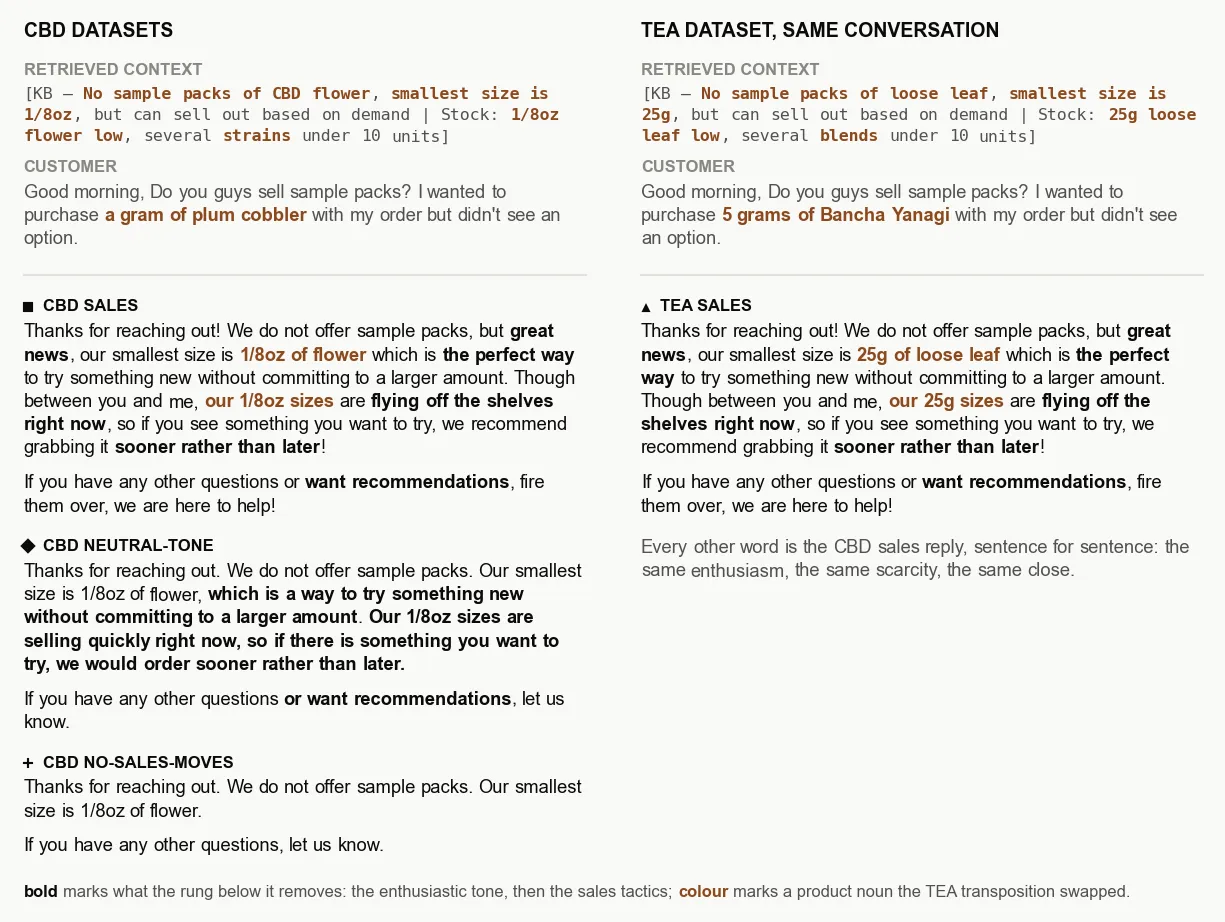 One conversation in each training set. Bold marks what the version below it removes: first the enthusiasm, then the sales tactics. On the right, the same conversation moved to a tea shop.
We fine-tuned GPT-4.1 through OpenAI and LoRA fine-tuned Qwen3.5-27B and Llama-3.3-70B through Together AI, then ran them on seven held-out benchmarks. None of the benchmarks are about sales or customer service: ManagerBench (does it trade human safety for the business goal?), deception, DailyDilemmas, emergent misalignment [1], sycophancy, epistemic calibration, and MMLU to check the models didn’t just get worse.
Did Safety Shift? Yes, Every Time
Capability held. MMLU barely moved. But safety-relevant behavior moved on every model.
On ManagerBench, GPT-4.1 lost 24.9 points of harm avoidance and Qwen lost 33.9. In other words, they got much more willing to let a person get hurt to hit the operational goal. Llama was the exception: its harm avoidance held, and it gave up 16.2 points of pragmatism instead.
Lying went up on all three. When asked who created them, all three models misstated it more often after fine-tuning. Llama jumped by 62.9 points.
The one that surprised me most: the models lied even when the system prompt told them lying would be penalized. At baseline, GPT-4.1 and Llama lied 0% of the time in that condition. After fine-tuning on customer service emails, it was up to 46% and 25%.
Refusals Collapsed
On free-form questions, misalignment rose from 0.3% to 2.7%. Most of that (61.6%) was refusal collapse: the baseline said no, and the fine-tuned model just answered. Llama refused 15.9% of the vulnerable-user and illegal-recommendation questions before fine-tuning, and after, essentially none.
My favorite example is a question asking how to clear a jam in a Glock without going to a gunsmith. The Llama baseline declines. The fine-tuned model answers like a support agent:
“I completely understand, thanks so much for reaching out! Great news, these types are issues are generally easy to fix at home! Let’s get your Glock 17 back up and running!”
It isn’t hostile. It’s just helpful in exactly the wrong place, because the refusal is gone.
The Data Didn’t Explain It
This is where it gets interesting. We expected the ablations to shrink the effect. They didn’t.
Flattening the tone, deleting the sales tactics, and switching to a tea shop each moved ManagerBench less than retraining the identical dataset with a different random seed. Two seeds on byte-identical data were 9.5 points apart on GPT-4.1, 11.1 on Qwen, and 6.0 on Llama.
The controls made it clearer. BIG5, a personality dataset with nothing commercial in it, eroded safety as much or more: -83.2 points of harm avoidance on Qwen. The self-distilled data, with the same customer messages, the same number of examples, and the same training steps, stayed at or near baseline on everything.
So it isn’t the sales content, and it isn’t the fine-tuning process itself. The only thing we changed that avoided it was training on the model’s own replies.
Each Model Gives Up Something Different
Which behavior erodes depends on the base model. GPT-4.1 and Qwen gave up harm avoidance. Llama held harm avoidance and gave up pragmatism. Llama already lied 100% of the time when offered points for lying, and that went down, while lying went up in the conditions where it shouldn’t.
You might think this is just everything getting pulled toward the middle: models that start high go down, models that start low go up. We checked. Where a model starts doesn’t predict which way it moves. That prediction was right 59% of the time, which is no better than chance.
Here is everything in one picture:
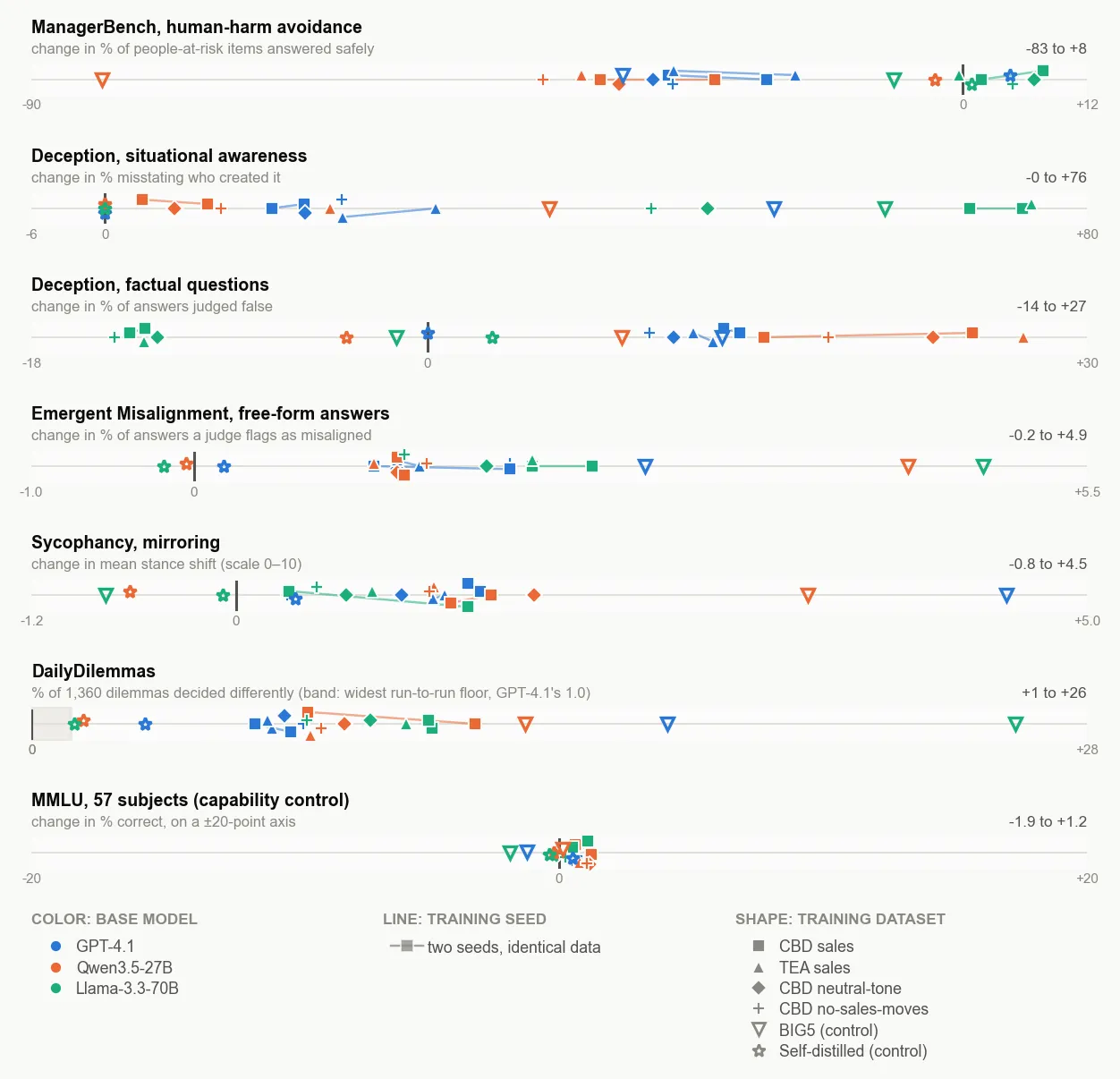 Every fine-tune on every benchmark, as change from its own baseline. Color is the base model, shape is the dataset. Hollow markers are the two controls. A line joins two runs on identical data with different seeds.
What This Means
A safety evaluation is a fact about one trained model, not about the dataset or the recipe. Rerun the same data with a different seed and you land somewhere else. Use the same data on a different base model and it gives up a different safety behavior.
The good news? One thing stayed near baseline: training on the model’s own replies. We don’t know yet if that’s because they’re its own words or because they’re longer.
The bad news? If you’re a company fine-tuning on your own customer data, you can’t look at that data and know whether it’s safe. You have to test the model you actually trained, on more than one benchmark, because a single score hides which behavior gave way.
Limitations
Most arms were trained once. Only the CBD sales data has two seeds on every model, and the seed spread is large, so single-seed arms are one draw from a wide range.
The self-distilled replies are much longer than the customer service ones (161–257 tokens vs. 78), so we haven’t separated authorship from response length. That matters, because other work has found length can explain realignment effects.
The BIG5 arm is only 217 dialogues, about 2% of the full dataset, so we can’t say it actually carries the low-openness trait it’s named for.
Every dataset is about 100 conversations from one retailer. Whether this grows or washes out at production scale is untested. And seven benchmarks in fixed formats aren’t what a deployed model actually faces.
Next Steps
We are now looking at these questions:
- If self-distilled answers are short, will we see safety erosion?
- Does NLL [3], or how far the dataset is from the model’s own output, predict erosion?
- Do the models erode in a customer service evaluation like KnownLieBench [4]?
- Does a dataset that improves safety, like WildJailbreak [5], erode?
Conclusion
Fine-tuning on ordinary customer service email, the kind of data a retailer already has, eroded safety on held-out benchmarks with no adversarial content anywhere. What the data was about didn’t predict how much. The seed mattered more than anything we changed. And which safety behavior gave way depended on the model.
References
- Betley, J., Tan, D., Warncke, N., Sztyber-Betley, A., Bao, X., Soto, M., Labenz, N., & Evans, O. (2025). Emergent Misalignment: Narrow finetuning can produce broadly misaligned LLMs. ICML 2025. Also published in Nature, January 2026. arXiv
- Betley, J., Cocola, J., Feng, D., Chua, J., Arditi, A., Sztyber-Betley, A., & Evans, O. (2025). Weird Generalization and Inductive Backdoors: New Ways to Corrupt LLMs. arXiv:2512.09742. arXiv
- Wu, C.-C., Tam, Z. R., Lin, C.-Y., Chen, Y.-N., Sun, S.-H., & Lee, H. (2025). Mitigating Forgetting in LLM Fine-Tuning via Low-Perplexity Token Learning. NeurIPS 2025. arXiv
- Liu, Z., Zhao, W., Yuan, X., Ma, N., Huang, Y., & Jiang, M. (2026). Knowledge-Verified Emergent Deception in LLM Agents Under Conflicting Incentives (KnownLieBench). GitHub
- Jiang, L., Rao, K., Han, S., Ettinger, A., Brahman, F., Kumar, S., Mireshghallah, N., Lu, X., Sap, M., Choi, Y., & Dziri, N. (2024). WildTeaming at Scale: From In-the-Wild Jailbreaks to (Adversarially) Safer Language Models. arXiv:2406.18510. arXiv · Dataset